London’s foray into sports history began in 1877 when W.J. Reid drained the land on the side of the Thames River to create a baseball diamond. Today, Labatt Park is widely considered the oldest continuous baseball diamond in the world and in 1994 was designated as an Ontario Historic Site.
London’s foray into sports history began in 1877 when W.J. Reid drained the land on the side of the Thames River to create a baseball diamond. Today, Labatt Park is widely considered the oldest continuous baseball diamond in the world and in 1994 was designated as an Ontario Historic Site.
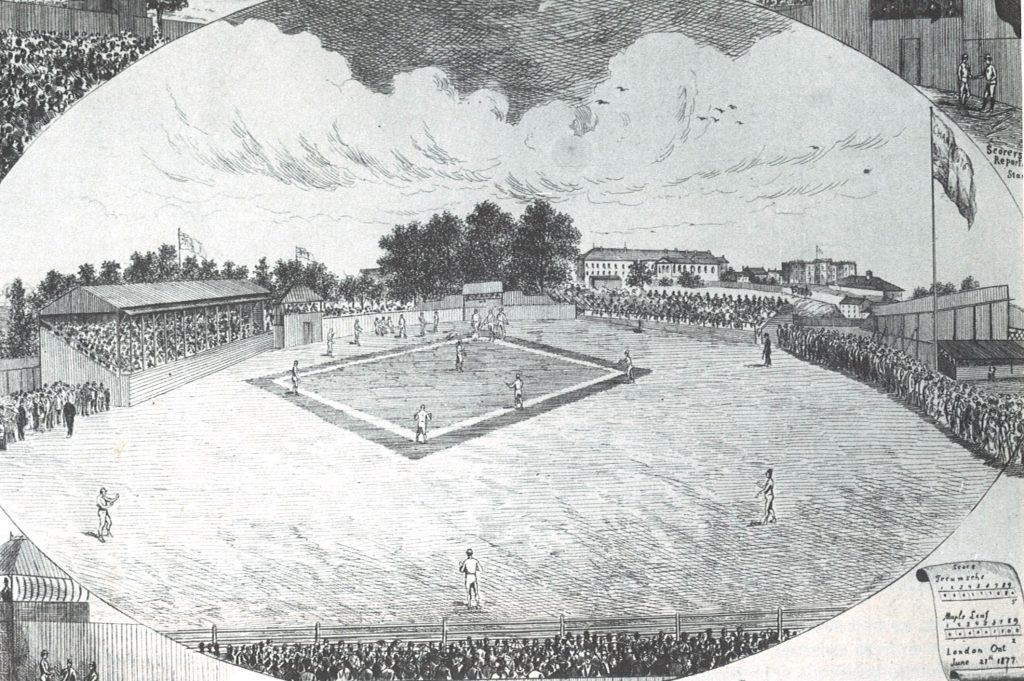
W.J. Reid established the field and christened it Tecumseh Park, with the local team named the London Tecumsehs. The first organized ballgame was played here on May 3, 1877 and was between the London Tecumsehs and the London Atlantics. The first international game was played next day, on May 4, against the Hartfords of Brooklyn with the London Tecumsehs defeated. Since then, the Park has hosted various teams including the London Colored Stars in the 1920s, which was one of London’s earliest black baseball teams; the London Supremes, a women’s league in the 1940s; the London Monarchs; and the London Majors.
Tecumseh match June 27, 1877. Courtesy of Western Archives and Special Collections.
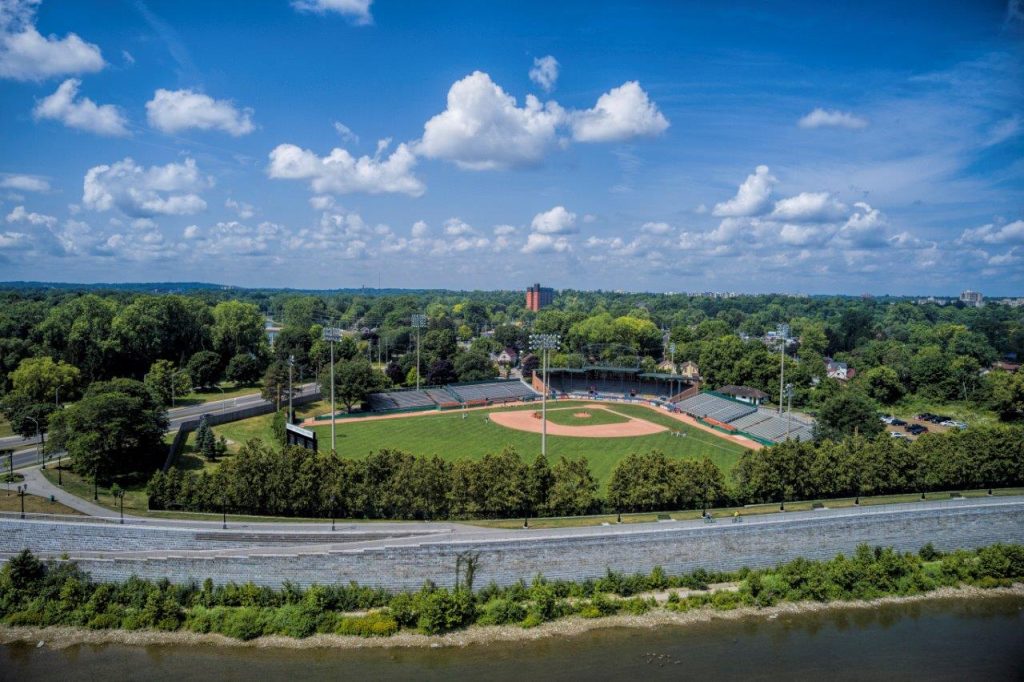
Over its 149-year history, Labatt Park has undergone a host of changes, including renovations and a name change. One of the first alterations to the site came with the 1883 Flood of London, when parts of the field and grandstand were damaged due to the rising Thames River. At this time, the stands were replaced, and minor improvements were made. In 1936, the Labatt Family donated $10,000 to renovate the park including a new clubhouse, (which would be necessary in the following year), and the park was renamed John Labatt Memorial Athletic Park. The baseball diamond would be under water once again in 1937 when London’s largest flood destroyed the grandstands and constituted another rebuild. A few years later, electric lights were installed in the Park to allow for nighttime baseball, and an Art Deco arch was added to the entrance off Riverside Drive. This archway would be demolished in the 1980s. Throughout the 1990s, the baseball diamond was kept in such great condition, that it won the Beam Clay Baseball Diamond of the Year Award on January 20, 1990, for outstanding maintenance. In 1996, the clubhouse was renamed for former London Majors’ pitcher Roy McKay, and small updates were made. In 2001, a new accessible grandstand was added as was new irrigation.
Labatt Park, image courtesy of Joe O'Neil.
Labatt Park, though home to London baseball, has also been the site for other recreational use over its long history. In the 1890s during London’s “bicycle craze” it was used to host amateur and professional bicycle races with trails added close to the Park’s entrances. In 1895 the first motion picture in London was displayed here drawing a large crowd of enthusiastic early movie-goers. It has also been used for soccer, softball, track and field, showjumping, and for civic receptions, including Queen Elizabeth’s 21-gun salute during her visit in 1997. There was even a wedding on Homeplate in 2005!
Labatt Park continues to be important to the fabric of the city, as a historic venue, and a continued place for recreation and celebration. In 2005, the Park helped celebrate the City of London’s 150th anniversary with a day long baseball clinic and ball game. In 2015, Labatt Park partnered with Eldon House to help celebrate the museum’s 180th birthday and our displays on historical baseball with a recreation of a London Tecumsehs game. Next year, it will be celebrating its own 150th anniversary, and we look forward to seeing all the Park has in store. To learn more about Labatt Park, including tours, visit: https://www.labattparktours.com/